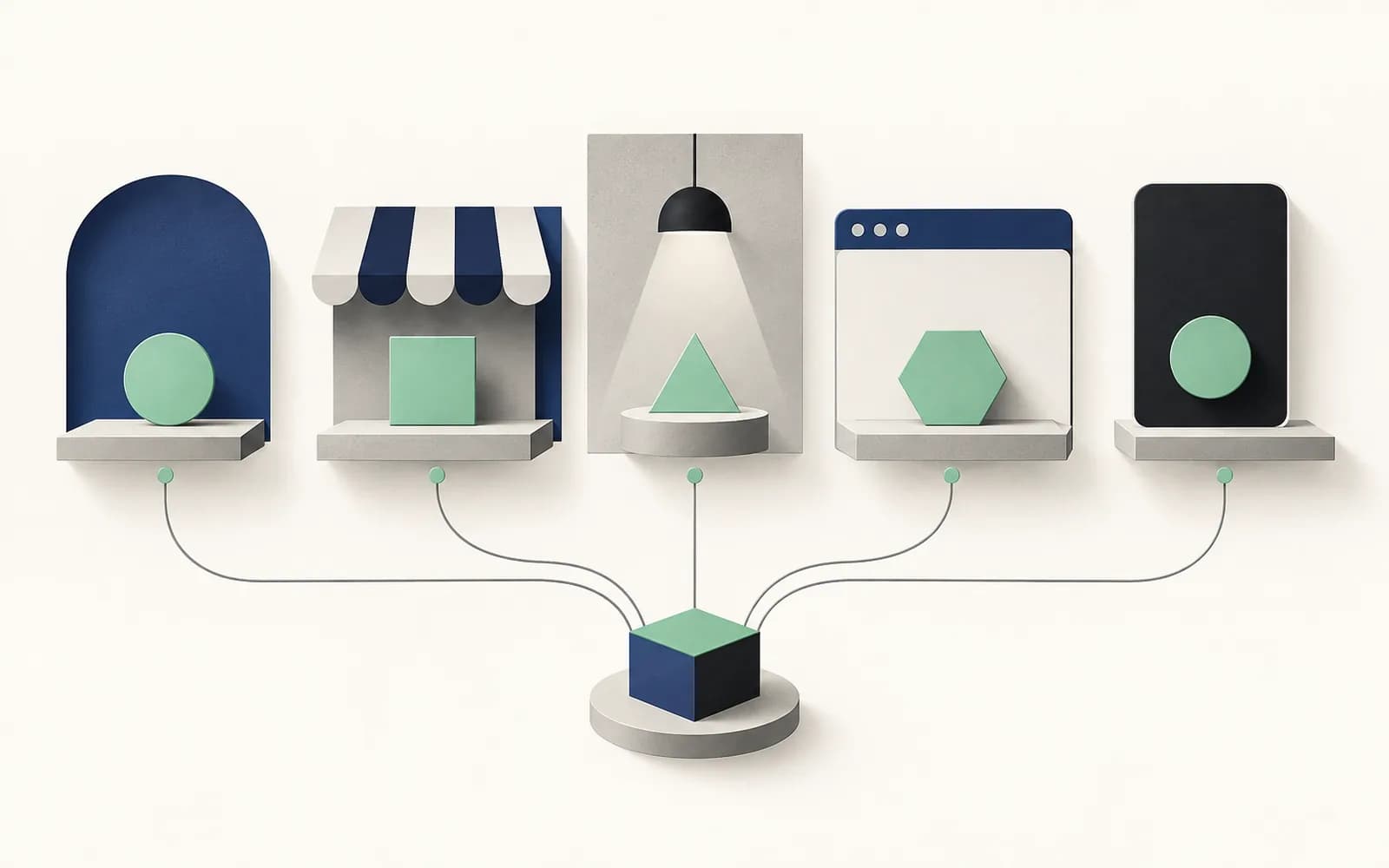
You have built something useful. The next question decides whether it earns anything: where do people find it?
There is no single best answer, because the channels differ in who they reach, what they take, and how much control they leave you. Here is what each one is actually good for.
Your own website
Reach: whatever you create. Cost: no fee, all the effort.
Selling direct gives you everything — pricing freedom, the customer relationship, the email list, the margin. Nothing sits between you and the buyer.
The catch is that every visitor is your problem, permanently. You are buying ads, ranking in search, or building an audience, and none of those are faster than the build was. For a builder without an existing following, direct-only is the slowest route to the first hundred customers.
Best for: products with a clear repeat-use case, where the lifetime value justifies acquisition cost, and builders who already have an audience.
Consumer AI stores
Reach: very large. Cost: high competition, limited pricing control.
The GPT Store and Poe put products in front of people already inside an AI product looking for something to do with it. Poe pays creators directly; the GPT Store's value is largely exposure.
The trade is that you are one listing among enormous numbers of them, most discovery happens through the platform's own surfaces, and you have little influence over how you are ranked or presented.
Best for: consumer-facing tools with an immediately obvious use, where a small conversion rate on very large traffic still adds up.
Developer hubs
Reach: moderate but highly relevant. Cost: monetisation is often indirect.
Hugging Face Spaces, LangChain Hub, and MCP directories reach developers specifically. The audience is technical, evaluates quickly, and will read your documentation.
Direct monetisation is frequently limited — these are often credibility and adoption channels rather than checkout channels. Value tends to arrive as pull-through: developers adopt the open thing, then pay for the hosted or supported version.
Best for: infrastructure, libraries, and developer tooling where adoption precedes revenue.
Agent marketplaces
Reach: growing quickly. Cost: a revenue share, and platform-shaped constraints.
Agent-specific markets — Replit's among them — are the closest thing to a conventional app store for agents, with support for direct purchase, subscriptions, and one-time unlocks. Platform galleries from Vercel and Cloudflare serve their own developer bases.
This category is the newest and the most fluid, which cuts both ways: less established demand, but less competition than the consumer stores.
Best for: agents that perform a defined task and can be demonstrated in a short interaction.
Enterprise channels
Reach: small numbers, large deals. Cost: long cycles and real compliance work.
AWS Marketplace, Salesforce AppExchange, and ServiceNow's store reach buyers with budgets and procurement processes. Deal sizes dwarf every other channel.
You pay for that in cycle length and requirements — security review, data handling documentation, support commitments. This is not a channel you add casually; it is a business model decision.
Best for: products serving a business process, where a single customer is worth months of effort.
Communities and launch platforms
Reach: a spike, then decay. Cost: goodwill if you get it wrong.
Developer communities, niche forums, and launch platforms produce a burst of traffic and, more usefully, direct feedback from people who have the problem.
Treat these as research, not a revenue channel. Launch traffic decays within days and cannot be repeated often. What you keep is a first cohort and a clearer idea of what to build next.
Best for: validating positioning and finding early users, at any stage.
Reselling the whole product
If you would rather exit than operate, marketplaces such as MicroAcquire and Flippa broker sales of small software businesses. Buyers typically want demonstrated revenue and low operational burden, so this is a route for products with traction rather than for finished-but-unlaunched projects.
Choosing between them
ChannelReachYour cutControlEffortOwn siteSelf-generated100%FullOngoing, highConsumer AI storesVery highVariesLowLow to listDeveloper hubsTargetedOften indirectMediumMediumAgent marketplacesGrowingRevenue shareMediumLow to listEnterprise channelsLow volume, high valueRevenue shareLowVery highCommunitiesSpike100%FullLow, non-repeatable
Most builders should not pick one. A workable pattern is your own site as the home and system of record, one marketplace matched to your audience, and communities for feedback. What does not work is listing everywhere at once — each channel needs its own positioning to perform, and thin presence across six is worse than real presence on two.
The thing nobody tells you about marketplaces
Listing is not distribution. A marketplace solves the problem of where people look. It does not guarantee that they find you. On a large platform you are competing with thousands of listings, and discovery inside the marketplace becomes its own optimisation problem — title, description, category, first impression, early reviews.
Marketplaces help most when the audience is specific enough that a good product visibly stands out. On very large general stores, the same dynamic that gives you reach also buries you.
This is part of a broader guide to monetizing what you build with AI, which covers pricing, distribution, and discovery end to end.
Frequently asked questions
What is the best platform to sell AI tools?
The one whose audience matches your buyer. A developer tool belongs where developers already are; a consumer utility belongs in a consumer store; a business process tool belongs in an enterprise channel. "Best" is a property of the match, not the platform.
Can I sell on a marketplace and my own site at the same time?
Usually yes, and most builders should. Keep pricing consistent so the marketplace does not undercut your direct channel, and check the terms for exclusivity clauses before listing.
How do I sell software online without an audience?
Go where the audience already exists — marketplaces, communities where your buyer's problem is discussed, or partnerships with tools your buyer already uses. Building an audience is a valid strategy but a slow one, and it is worth starting the other route in parallel.
Kaino Marketplace is the software economy for the AI era, built for AI builders, founders, agencies, and teams creating AI-native software. It is in beta and you can register for access through the Kaino Marketplace waitlist.
For comparison against the channels above: there is no listing fee and no subscription. Kainotomic takes 15% of revenue, you keep 85%, and payouts are monthly. Listing something that earns nothing costs nothing, which makes it a low-risk addition alongside whatever channel you already use.